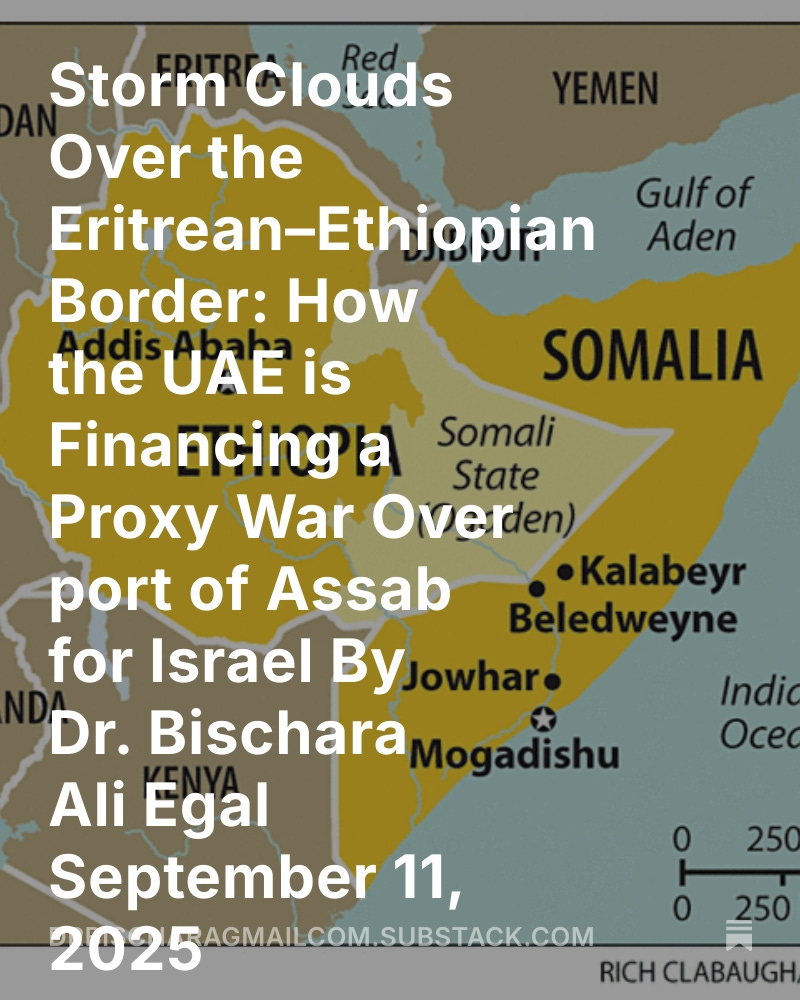
Storm Clouds Over the Eritrean–Ethiopian Border: How the UAE is Financing a Proxy War Over Assab for Israel.By Dr. Bischara Ali Egal September 11, 2025
P.O. Box: 1978, | Tel: +252 615545915 | +252 616004764
Website: www.horncsis.org / Email: bischara@yahoo.com | info@hornscsis.com | drbischara@gmail.com
The Horn of Africa
Storm Clouds Over the Eritrean–Ethiopian Border: How the UAE is Financing a
Proxy War Over Assab for Israel
By Dr. Bischara Ali Egal September 11, 2025
Introduction: A Manufactured Confrontation
The Horn of Africa is on the edge of a catastrophic confrontation. Ethiopia and
Eritrea are once again facing off, this time over the strategic Eritrean port of Assab.
On the surface, this is a bilateral dispute. In reality, it is a proxy war being
manufactured by external actors — chiefly the United Arab Emirates (UAE) and
Israel — using Ethiopia’s domestic crisis as leverage.
Abyssinia as African Colonial Empire
While Ethiopia is celebrated as an African state that resisted European colonization,
it was itself a colonial empire dominated by the Amhara elite. Oromos, Afars, and
Somalis were forcibly incorporated, subjected to land grabs, and cultural
suppression. Even Tigrayans faced violent repression when they resisted central
rule. Ethiopia’s expansionist claim to Assab must be understood as a continuation
of this imperial legacy.
Ethiopia’s 2026 Elections and the Politics of War
With Ethiopia’s general elections scheduled for June 2026, Prime Minister Abiy
Ahmed is mobilizing nationalist rhetoric to shore up his rule. His declaration in 2023
that “120 million Ethiopians cannot remain landlocked forever” reflects not just
strategic need, but political survival. By promising sea access, Abiy seeks to unify a
fractured country and distract from insurgencies in Oromia and Amhara.
UAE’s Maritime Empire and Red Sea Strategy
The UAE has systematically established a maritime empire across the Horn of Africa
and beyond. Through DP World, it controls Berbera and Bosaso. In Yemen, it
operates from Aden, Mukalla, and Socotra. In Eritrea, it leased Assab in 2015.
The Horn of Africa
Center for Strategic and
International Studies
(The Horn CSIS)
P.O. Box: 1978, | Tel: +252 615545915 | +252 616004764
Website: www.horncsis.org / Email: bischara@yahoo.com | info@hornscsis.com | drbischara@gmail.com
The Horn of Africa
These ports, nominally commercial, function as strategic bases. Since the Abraham
Accords, they also serve Israeli objectives, turning the Red Sea into a militarized
zone.
Israel’s Red Sea Strategy: The Hidden Hand
Israel regards the Red Sea as a strategic frontier. Assab offers vantage points to
monitor Egypt’s Suez Canal, counter Saudi naval presence, and disrupt Iranian
supply to the Houthis. By outsourcing its operations to the UAE, Israel secures
deniability while embedding itself across the Horn. Eritrea’s ports are pawns in this
broader strategy of militarization.
Eritrea’s Isolation and Vulnerability
Eritrea’s regime, led by Isaias Afwerki, is militarized but fragile. International
sanctions, economic stagnation, and decades of authoritarianism have left it
isolated. Leasing Assab to the UAE in 2015 compromised Eritrea’s sovereignty, and
now with Abu Dhabi shifting toward Addis Ababa, Asmara is dangerously exposed.
Regional Fallout
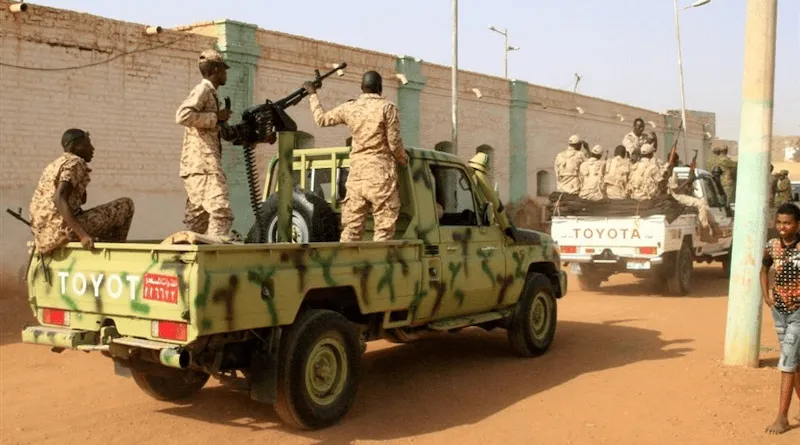
A war over Assab would destabilize the Horn and beyond. Sudan, already in civil
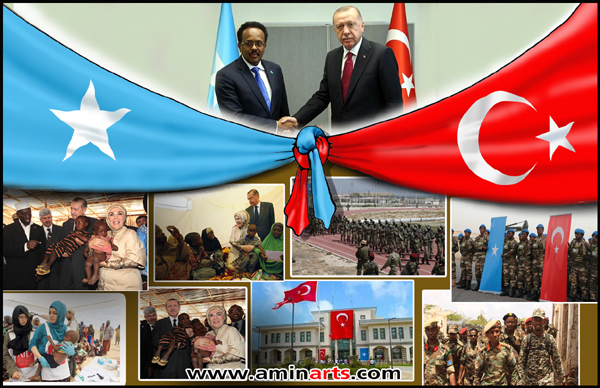
war, would collapse further. Somalia, trapped between Turkish and Emirati
influence, would lose more sovereignty. Yemen’s Houthis would escalate Red Sea
attacks. Global trade through Ba al–Mandab, which carries 10 percent of world commerce, would be jeopardized.
Conclusion: Resisting Proxy Wars
The looming Ethiopia–Eritrea conflict is not inevitable. It is being engineered by
foreign actors — the UAE and Israel — and fueled by Abiy’s political desperation.
The peoples of the Horn must resist becoming pawns in this proxy war. Sovereignty
and solidarity are the only alternatives to endless cycles of foreign–driven conflict.
Address: Jidka Wadnaha, Hwy; KPP Hodan District, Mogadishu, Somalia
P.O. Box: 1978, | Tel: +252 615545915 | +252 616004764
Website: www.horncsis.org / Email: bischara@yahoo.com | info@hornscsis.com | drbischara@gmail.com
The Horn of Africa
Bibliography (Selected, Chicago Style)
– Alex de Waal. The Real Politics of the Horn of Africa: Money, War and the Business
of Power. Cambridge: Polity Press, 2015.
– Bahru Zewde. A History of Modern Ethiopia, 1855–1991. Oxford: James Currey,
2001.
– International Crisis Group. Ethiopia and Eritrea: Preventing War over the Red Sea.
Brussels: ICG, 2023.
– Reuters. “Ethiopia’s Abiy Says Red Sea Access Is a Necessity, Not a Choice.” October
2023.
– Middle East Eye. “Revealed: UAE Deploys Israeli Radar in Somalia under Secret
Deal.” July 2024.
– Roland Marchal. “Red Sea Politics: Ports and Power.” Horn of Africa Network
Papers, 2022.
– Associated Press. “UAE Expands Port Holdings in Yemen.” July 2021.
– Mary Harper. Everything You Have Told Me Is True: The Many Faces of Al–Shabaab.
London: Zed Books, 2019.
Prof. Dr. Bischara Ali Egal,
Executive Director and Chief Clinical Researcher
Canada Specialized Hospital (1998) Inc.,
Jidka Wadnaha Hwy., KPP, Hodan.
Tel: +252–1–655914/15 Office
+252–615545915 Mobile/Whatsapp
www.somalihealthcenter.org
http://kanadahospital.com